

After years of scaling back his overseas travel, this weekend Xi Jinping will begin an extraordinary diplomatic whirlwind stretching across the next four weeks. The individual stops have attracted attention. But I haven’t yet seen much discussion of this diplomatic offensive as a coherent whole—and there should be, because Xi’s itinerary carries a potent message.
On August 30, Xi will travel to Bishkek, Kyrgyzstan, to attend the Shanghai Cooperation Organization summit, paying a state visit there before going onward to Egypt. Xi is also expected to travel to India for the BRICS summit on September 12-13 and to visit Washington for the first time in over a decade on September 24.
That would be a formidable travel schedule for any leader, but it’s particularly striking for the 73-year-old Xi, who had seemed to prefer bringing the world to Beijing—underscoring China’s centrality and autonomy on the world stage—rather than shlepping to foreign capitals.
Why is Xi embarking on this moment of globetrotting right now? Xi appears to see an opportunity to show that China has friends and options around the world at precisely the moment Washington is alienating many of its allies. This is not simply a well-trodden story about China rising and America declining. Xi’s diplomatic offensive will aim to drive home a more specific and powerful point: Beijing can deepen its influence across Eurasia and the Global South, build institutions around its own priorities—and then arrive in Washington to be feted by the American president. Put another way, China can build an international ecosystem less centered on Washington while managing—and extracting benefits from—Washington itself.
First, let’s look at the overall trends in Xi’s diplomacy.
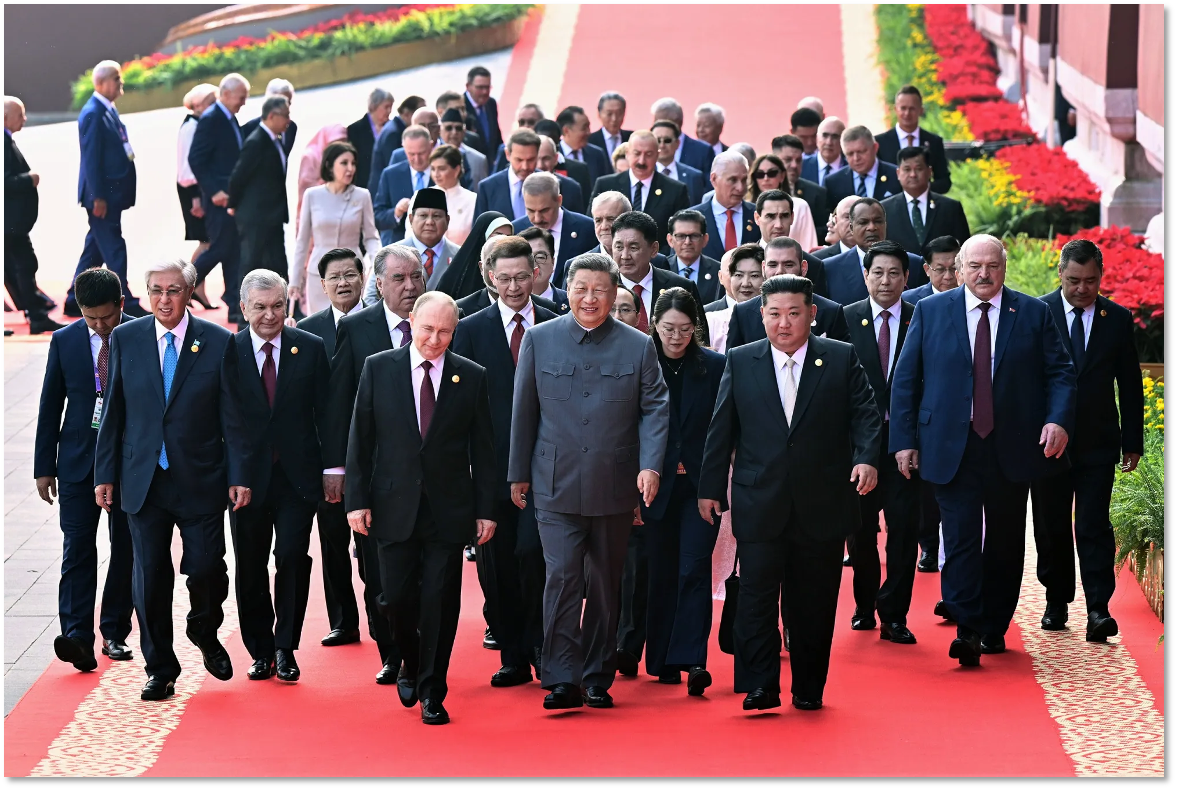
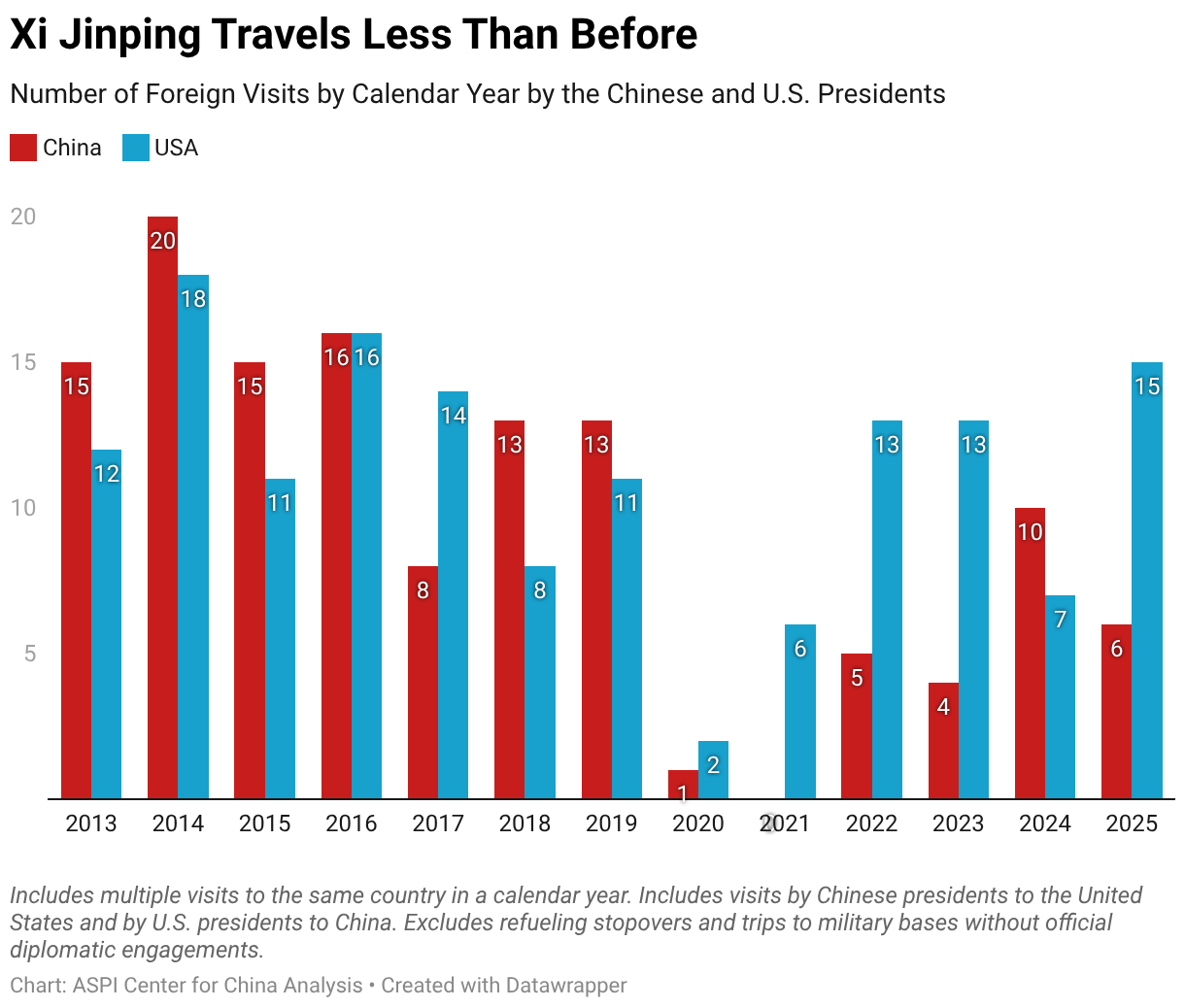
In 2014, at the beginning of his tenure, Xi Jinping visited roughly 20 countries in one year. During the COVID-19 pandemic, these numbers plummeted, with Xi traveling abroad once in 2020 and zero times in 2021. He has gradually begun building up his travel schedule again, visiting ten countries across four overseas trips in 2024 and six countries in 2025, but the direction has been clear: Xi is going abroad less, and more world leaders are going to Beijing. The contrast has been especially vivid over the past year. Xi gathered SCO leaders in Tianjin in late summer 2025, then welcomed a parade of foreign leaders to China in early 2026—including those of Canada, Britain, Germany, Spain, the United States, and Russia.
Xi’s coming burst of overseas diplomacy fits Beijing’s growing sense of strategic opportunity. Based on a quick review, the coming month seems to be the first time since June 2019—when Xi made four separate foreign trips, which China state media touted as “a new record in the diplomatic history of the PRC”—that he’s maintained this density of international travel. Neil Thomas and Yuxuan Wei have a great dataset of trends in Xi’s travel:
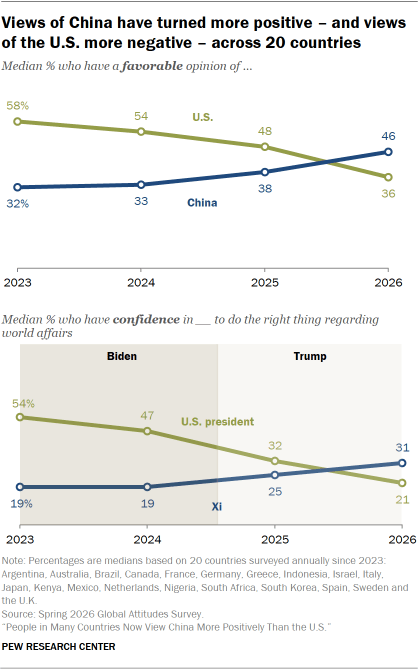
Recent international polling lends support to Beijing’s optimism about a favorable moment. Pew Research has shown that China is now viewed more favorably than the United States in most of the countries it surveyed—and that more people across those countries express confidence in Xi than in Trump, although Xi’s own ratings remain quite low:
Pew also reported: “People in 17 middle-income countries raise more concerns about the United States’ foreign policy than China’s. A median of 75% say that the U.S. interferes in the affairs of other countries a great deal or a fair amount, while 45% say the same of China. In nearly every country surveyed, more people see the U.S. as an interferer than China.” Against the backdrop of everything from “Liberation Day” tariffs to the Iran war, Xi is focused on presenting China as a steady partner offering “mutual benefit,” in deliberate contrast to Washington’s transactional and often erratic approach—a powerful message even for countries wary of becoming over-reliant on China.
Although China’s relationships with Kyrgyzstan, Egypt, and India are all quite different, in each case Xi sees opportunities; Egypt, for example, has expanded its ties with Beijing—from joining BRICS and defending China’s repression of the Uyghurs in Xinjiang to using Huawei technology to build its telecommunications infrastructure—and Huawei is now bidding to build AI data centers for the Egyptian government.
Yet China’s aims are far broader than making progress on these specific bilateral relationships. The influential Chinese international relations scholar Wu Xinbo made this logic unusually explicit in July. Changes in American global leadership, he argued, have created “an important historical opportunity” for China to play a larger role in global governance. Beijing’s next challenge is to turn Xi’s Global Development, Security, Civilization, and Governance Initiatives into concrete results. “Global governance cannot rely solely on conceptual initiatives,” he said, “and if the UN headquarters one day moves from the Hudson to the Huangpu, China must prepare the necessary resources, physical space and professional talent in advance.” Organizations like the SCO and BRICS are central to this effort, as Jeff Prescott and I wrote in Foreign Affairs.
So how does Xi’s visit to Washington in late September 2026 fit into this diplomatic offensive?
Of course, Xi wants to extend the period of stability in U.S.-China relations, and his personal diplomacy with Trump has been the most effective way of securing that stability. (See my Substack preview of the Washington summit here.) But the sequencing of his upcoming diplomacy sends a different message: China is expanding its global influence while managing the United States on terms Beijing finds increasingly favorable.
Looming over all of this is the question of whether Xi Jinping will deliver a speech at the UN General Assembly (UNGA) in New York, which falls during the exact week that Xi is already on the East Coast of the United States. It would be an easy strategic win, driving home the contrast with Trump’s hostility toward the multilateral system, so it’s worth keeping an eye on. There’s direct precedent here: In 2015, Xi Jinping visited Washington on September 24-25 (almost exactly the same dates as this year), followed by a trip to New York to speak at UNGA—the last time he appeared there in person. If anything, Beijing has invested even more heavily since then in portraying China as a defender of the UN-centered multilateral system. Politico has reported that Xi does not intend to go to New York, and that’s totally plausible, but Beijing often waits until relatively close to Xi’s overseas trips to formally confirm his attendance and itinerary. Might he do the same this year?
Whether or not Xi attends UNGA, the broader message of his diplomacy is clear. In a prior era, American leaders once dreamed that they could set the terms of China’s rise. Today, few doubt that China is setting those terms for itself. Xi will spend September cultivating institutions and relationships meant to expand Beijing’s influence across Eurasia and the Global South, then fly to Washington to be welcomed by an American president eager to celebrate their relationship. For Xi, that sequence is not a contradiction. It is the point.
One does get the sense that we are living through a breathless moment of history, with change overlaid by a scaffolding that obfuscates the scale of where we are and where we are headed. From energy transitions to new defense arrangements to trade fragmentation and diversion, what Xi Jinping is offering the world, perhaps more than anything (and even if half-hearted), is a constant in an age of blurred lines and moving targets.