

Trump has now confirmed that Xi Jinping will visit the White House on September 24, 2026. The visit is meant to reciprocate Trump’s lavish reception in Beijing in May.
The White House has been somewhat coy about formally labeling it a “state visit,” which calls for elaborate ceremonies to honor a visiting leader. But Beijing says that is precisely what Xi was promised—and it’s hard to imagine Trump not vying to outdo the pageantry that he witnessed in China. Hosting the top Chinese leader at the White House is rarer than it might seem; the last time Washington hosted Xi for a state visit was 2015, over a decade ago. This is a major and unusual event.
Incredibly, Trump has scheduled this extraordinary spectacle less than six weeks before the midterm elections. Presidents ordinarily have strong incentives to avoid honoring a deeply unpopular foreign rival on the eve of a close national election. (A mere 17 percent of Americans have confidence in Xi Jinping “to do the right thing regarding world affairs,” according to Pew Research.) Trump appears entirely untroubled by that risk. Is Trump signaling that he believes he has mastered the politics of U.S.-China relations? Or does he simply not care?
Assuming Xi gets the full state-visit treatment, there will be some highly visible elements worth watching closely—and aesthetics matter more in U.S.-China diplomacy than you might think. I saw the planning for several countries’ state visits up close during my years at the White House, and these visits also play an important role in the history I’m tracing in my forthcoming book on U.S.-China relations.
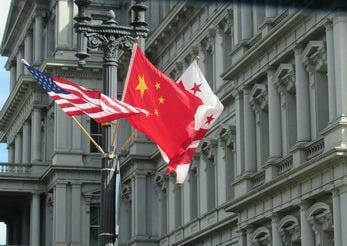
First, there are the flags. A lot of them. Big and small, pretty much everywhere the eye can see.
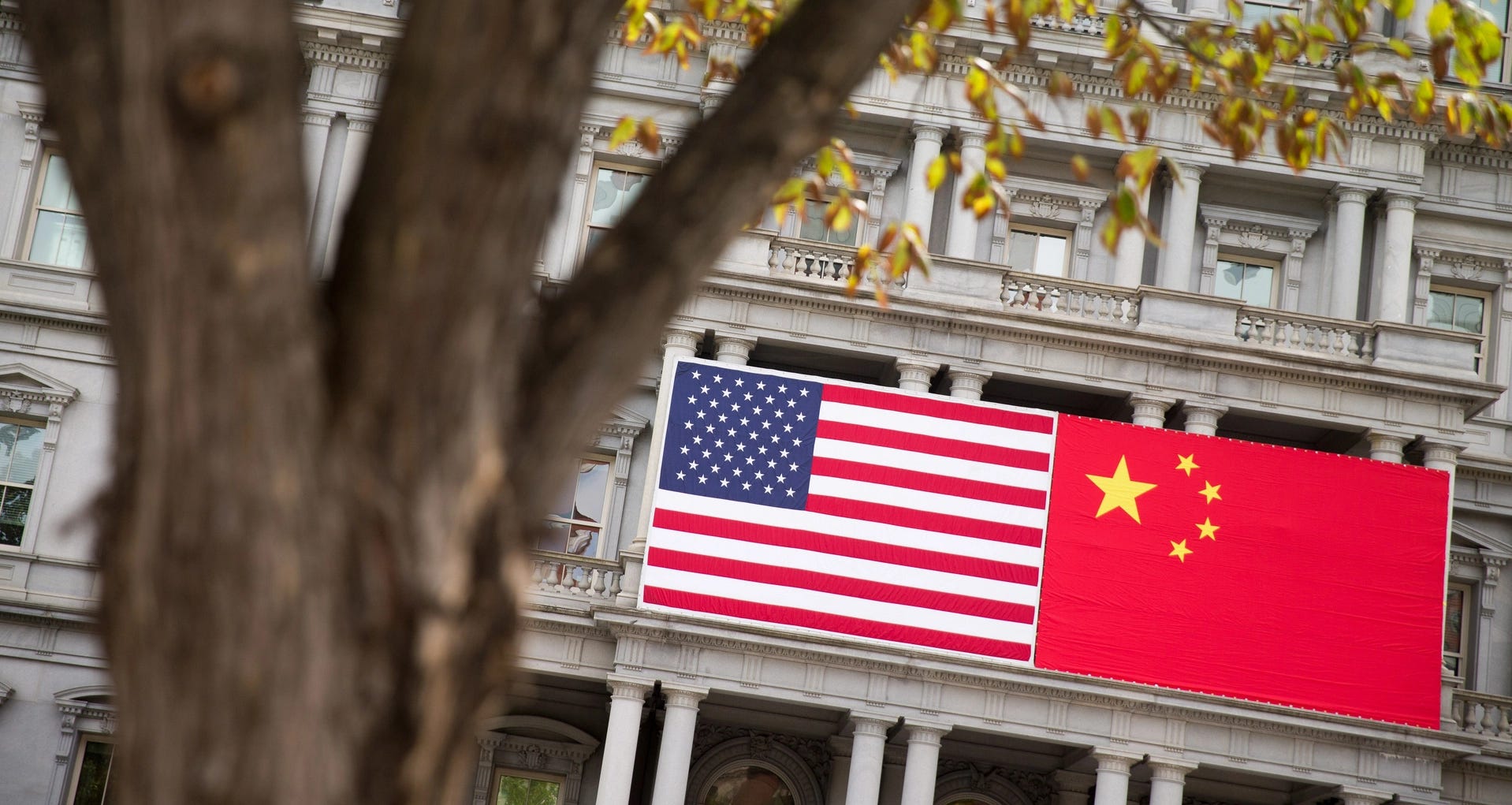
No, you’re not hallucinating: In 2015, on Xi’s last state visit, enormous American and Chinese flags proudly hung side by side on the Executive Office Building across from the White House. And similar pairings sprouted up all over Washington:
Then come the familiar rituals: the arrival ceremony on the South Lawn, the grand dinner with handpicked guests from business, entertainment, and politics, a press conference, meetings in the West Wing.
One event to watch could be a State Luncheon at the State Department, often hosted by the Secretary of State, sometimes along with the Vice President. China has a particularly fraught relationship with Marco Rubio, whom it sanctioned while he was a leading China hawk in the Senate. As Secretary of State, Rubio has followed Trump’s lead on a much more conciliatory policy toward a country he once called “the most potent and dangerous near-peer adversary this nation has ever confronted.”
The prospect of Rubio welcoming and toasting Xi at the State Department would be surreal indeed. But that protocol is precisely what happened on Xi’s last state visit. In 2015, Secretary of State John Kerry welcomed Xi with a few sentences in Chinese, prompting gasps and applause from the attendees and a broad grin from the usually taciturn leader. (See below for a cameo from then-protocol chief Qin Gang, who subsequently ascended to the position of China’s foreign minister before an untimely purge.)
State Dinners are also interesting, not least because the guest list gives a snapshot of precisely who the White House thinks matters for a given relationship. When Deng Xiaoping came to Washington in 1979, President Carter invited political leaders of both parties, marking former President Richard Nixon’s first official return to the White House after his resignation. Trump is unlikely to invite any of his predecessors this time around, but business leaders looking to do deals in China—of the sort he brought with him to China in May—will be vying for seats.
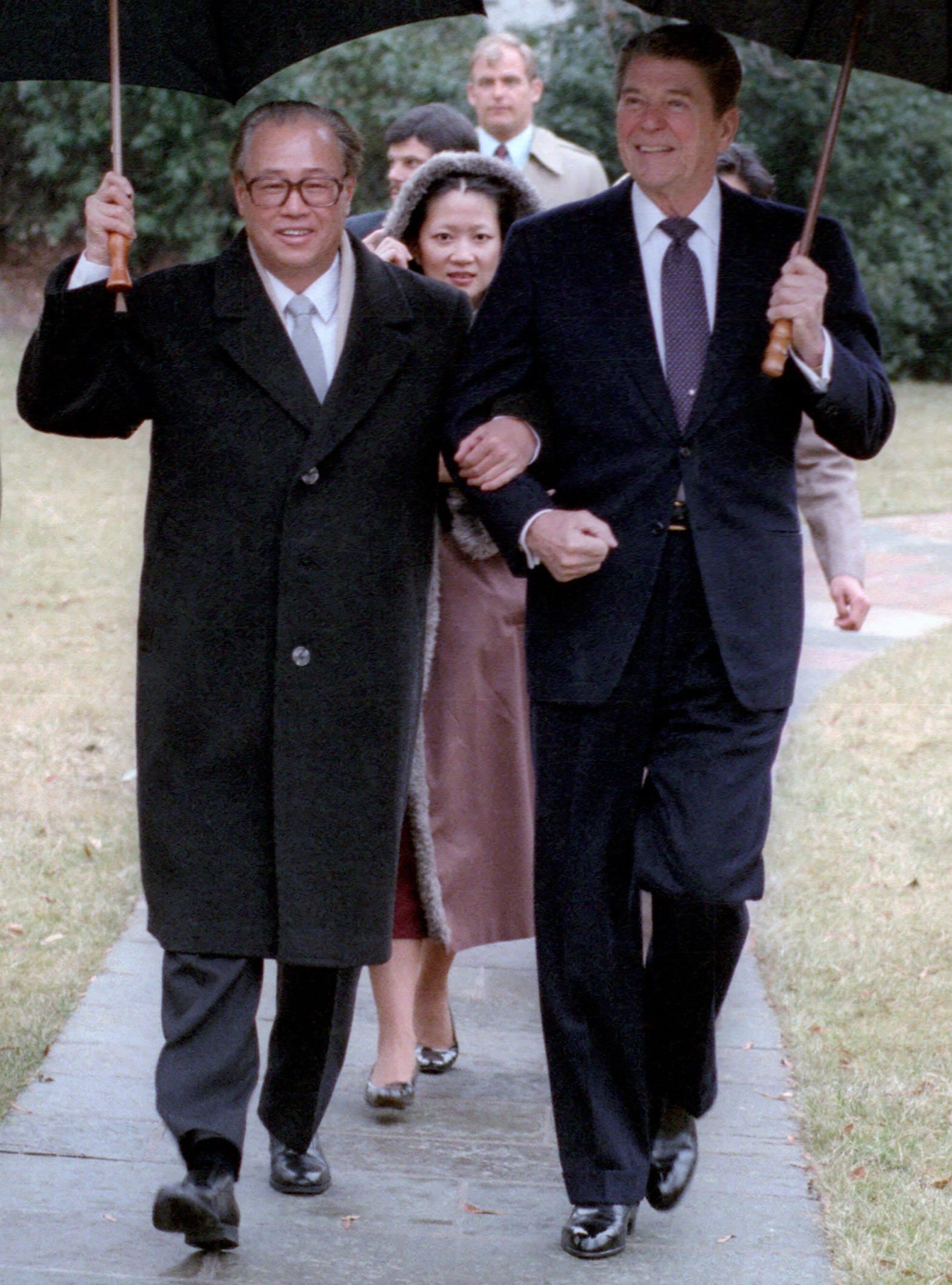
Outside of these formal events, having the Chinese leader in Washington also allows for more informal moments, as in this classic 1984 photograph of then-Premier Zhao Ziyang (purged in 1989) and Ronald Reagan walking arm-in-arm on the White House grounds, each jauntily holding umbrellas. This is precisely the kind of bonhomie Trump wants with Xi.
Despite the positive messaging, Beijing is deeply paranoid about sending its top leader into the lion’s den of Washington, D.C., and this has been true for decades. A former White House official told me that Chinese officials were deeply anxious that the Americans would find a way to “humiliate” Xi during the 2015 state visit. And that was the Obama administration. As Xi prepares to travel to Washington again, Chinese officials are already airing concerns through the press about alleged “chaos” in Washington’s planning.
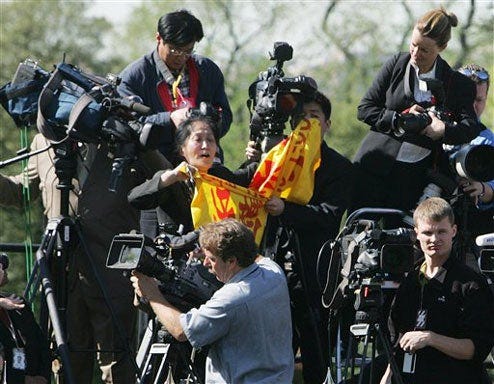
Even seemingly minor slip-ups can take on larger meaning. The canonical example of a visit gone wrong came in 2006, when Hu Jintao visited President George W. Bush at the White House. While not formally designated as an official state visit, Hu’s visit had many of the same trappings, including a 21-gun salute on the South Lawn of the White House. Yet this pageantry went awry when the announcer introduced the national anthems as Hu and Bush stood onstage: “Ladies and gentlemen, the national anthem of the Republic of China”—the official name of Taiwan! Making matters worse, as Hu and Bush made remarks, a protester disrupted the proceedings. Although Chinese state media censored these missteps, Hu was reportedly humiliated and angry. A lunch featuring ginger-scented dumplings and live bluegrass did little to patch things up.
Above all, Trump will aim to use the pageantry of his reception for Xi Jinping to advance his personal relationship with the Chinese leader. “It’s an honor to be your friend,” Trump said in Beijing to the far less voluble Xi. (Trump later acknowledged that, despite his overtures, Xi remained “all business.”) Across the extraordinary swings in Trump’s China policy over both his first and second terms, one element has proved remarkably durable: his determination to secure a strong personal relationship with Xi.
It’s fascinating to imagine Xi thinking back on his 2015 state visit and how much has changed in U.S.-China relations since then. I dug up the program for his arrival ceremony from the Obama archives—a few snapshots below, truly a relic from a different era:
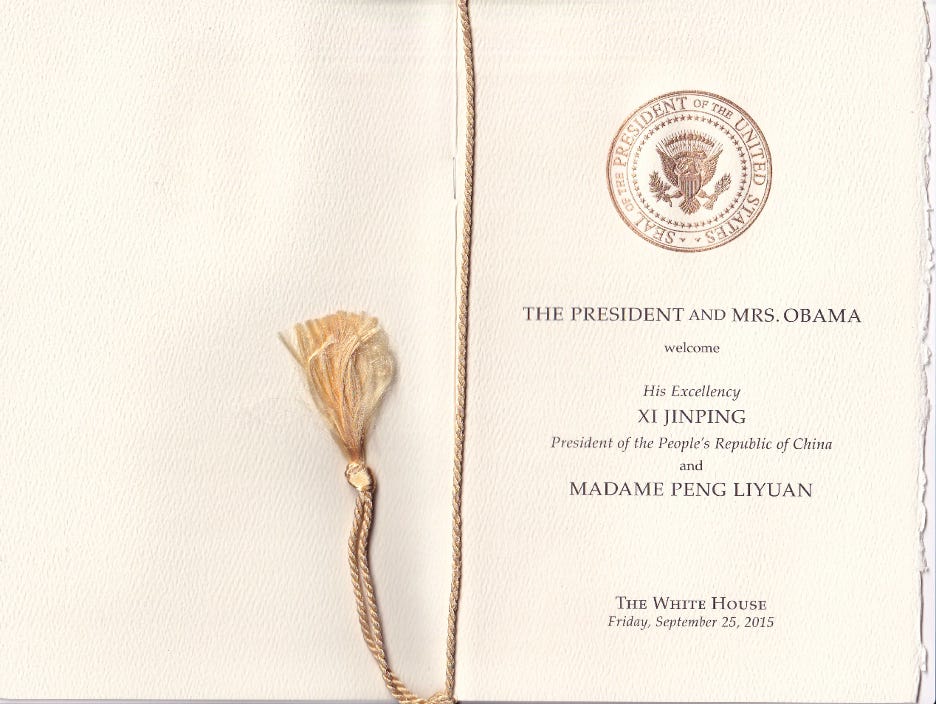
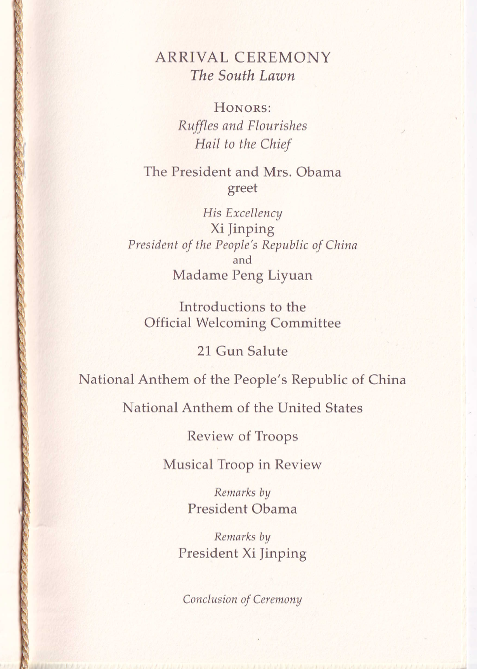
I also learned that, after the state dinner concluded that evening in 2015, the R&B singer Ne-Yo performed, because the White House Social Secretary learned that Xi’s wife Peng Liyuan, a professional singer, was a fan of Ne-Yo’s music. Peng reportedly sang along with the set, which Ne-Yo opened with his hit “Because of You.” The song describes someone helplessly consumed by an attraction he can’t shake. Alas, the song’s lyrics apply nearly as well to Trump’s hopes for his “friendship” with Xi today. “I got a problem and I don’t know what to do about it,” he sings. “It’s got me stuck between my fantasy and what is real.”
When Xi comes to Washington next month, we should all be asking what’s fantasy and what’s real.
To be precise, it was the Chinese Foreign Ministry that was outraged by the incident during Hu Jintao's lawn ceremony. I was in the Oval Office with President Bush immediately after the ceremony as Bush said to Hu "my mother taught me to treat guests better than this." Hu, who has a delightful personality in private, was extremely gracious about the entire affair.
On Nixon being at Deng's state visit, it is worth noting that he was still in disgrace, and only got his invitation because Deng said that if Nixon wasn't invited, he would make a detour to visit him in California instead, which would have been very inflammatory. But the invite marked the start of Nixon's political rehabilitation.